

By Katherine Wiseman | HighPoint Experience | Sales Enablement + Training
Pull up any medical device product launch timeline and you will find the same structure. Regulatory milestones are mapped in detail. Marketing deliverables have owners and deadlines. Manufacturing, supply chain, and commercial logistics all have their own tracks. The sales training line item, if it exists at all, usually shows up as a single block in the final two weeks before launch: “Sales Training.”
Two weeks. For the entire program that determines whether your field team can actually articulate what this product does, why it matters, and how it compares to the thing the surgeon has been using for the last decade.
That is not a training plan. That is a checkbox.
And the result shows up fast. Industry estimates suggest that 60 days after a medical device launch, a significant portion of reps still cannot deliver the core value proposition accurately and consistently. The message drifts. The clinical story gets simplified into something generic. The differentiation points that your marketing team spent months refining get lost in translation between the slide deck and the actual conversation in the OR or the procurement office.
The product is not the problem. The launch readiness training, or the absence of it, is the problem.
The Timeline Everyone Builds
Here is what a typical 12-month launch timeline looks like for a medical device company bringing a new product to market.
Months one through four are regulatory and clinical. The team is focused on clearance, labeling, and building the clinical evidence package. Months five through eight are marketing and commercial. Messaging gets developed, the sales deck gets built, the website goes up, and the trade show plan comes together. Months nine through eleven are manufacturing and logistics. Product is being produced, distributed, and staged for launch.
Month twelve is launch. And somewhere in that final month, someone schedules a national sales meeting or a series of regional sessions where the field team gets introduced to the product.
There is nothing structurally wrong with this timeline. Everything on it needs to happen. The problem is what is not on it.
There is no line for message internalization. There is no milestone for role-play certification. There is no checkpoint for objection handling competency. There is no plan for reinforcing the training after the initial session ends. And there is no metric for whether reps can actually deliver the clinical story in a way that moves an account from evaluation to adoption.
The launch timeline treats training as an event. Adoption requires training to be a process.
What Happens When Training Is an Afterthought
The consequences of compressed or missing launch readiness training show up in predictable ways.
Message inconsistency across the field.
When reps get one pass through the product training with no follow-up reinforcement, each rep fills in the gaps with their own interpretation. Within 60 days, you have as many versions of the value proposition as you have reps. The marketing team starts hearing from accounts that the product messaging is confusing. It is not confusing. It is just not consistent, because the training never built consistency.
Clinical credibility gaps.
Medical device sales require a level of clinical fluency that other industries do not. A rep selling to an interventional cardiologist or a wound care specialist needs to speak the language of clinical evidence, not just product features. Compressed training programs rarely have time to build that fluency. The result is reps who can present the deck but cannot answer the follow-up question, and that moment is where physician trust either builds or breaks.
Slow adoption curves.
Product adoption in medical devices depends on early account wins. The first 90 days of a launch set the trajectory. If reps are still figuring out the messaging during that window, they are not pursuing complex accounts or navigating multi-stakeholder buying processes. They are staying in their comfort zone with existing products, and the new product launch stalls before it starts.
Field team frustration.
Reps know when they are underprepared. They feel it in every conversation where they cannot answer a question cleanly, where they have to improvise around a gap in their knowledge. That frustration compounds. It affects confidence, it affects activity levels, and in a competitive labor market, it affects retention.
How to Build Training Into the Launch Timeline
The fix is not complicated. It requires treating training as a workstream with its own milestones, not as a single event at the end.
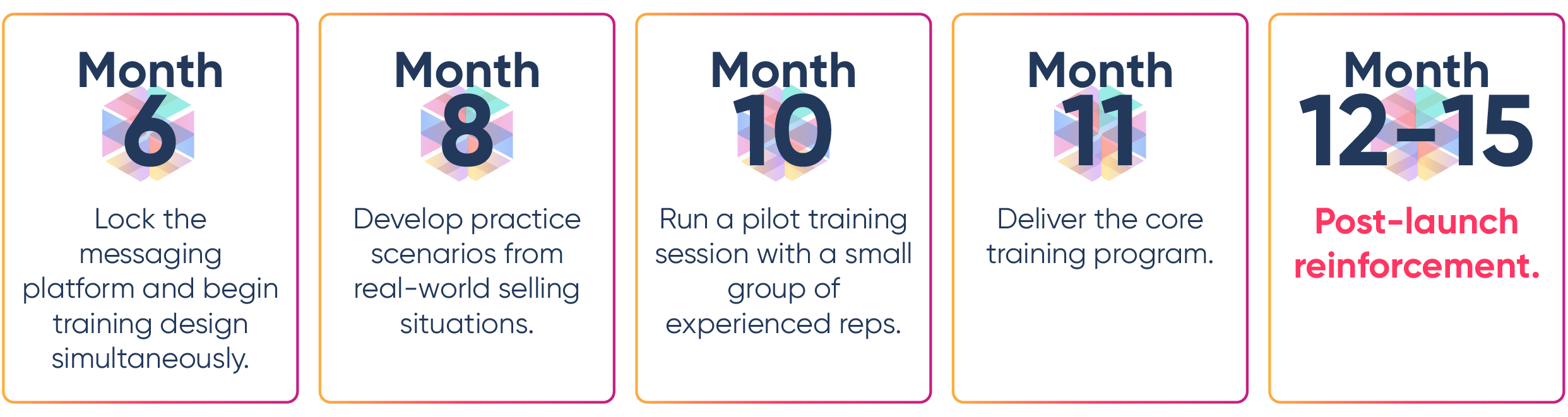
Month six: Lock the messaging platform and begin training design simultaneously.
As the marketing team finalizes the messaging architecture, the training team should be building curriculum from the same source document. Not waiting for the final deck. Working from the same messaging brief. This parallel track ensures training and marketing content tell the same story.
Month eight: Develop practice scenarios from real-world selling situations.
The best medical device training programs do not teach product features in a vacuum. They teach reps how to use those features in the context of the actual conversations they will have. That means building role-play scenarios around VAC committee presentations, one-on-one physician conversations, competitive displacement situations, and objection-heavy buying environments. These scenarios take time to develop well, which is exactly why they cannot be crammed into the final two weeks.
Month ten: Run a pilot training session with a small group of experienced reps.
Before the national launch training, put the curriculum in front of five to ten of your best reps and get their feedback. Where do they stumble? Where do they ask questions the training does not answer? Where does the message feel disconnected from what they experience in the field? This pilot round catches gaps that the training designers, no matter how good they are, will not see from inside the building.
Month eleven: Deliver the core training program.
This is the national sales meeting, the regional sessions, the virtual certification program. But because the groundwork started in month six, this is not a brain dump. It is a culmination. Reps have context. The materials reinforce what they are learning. The scenarios feel grounded in reality.
Months twelve through fifteen: Post-launch reinforcement.
This is the piece almost every company skips, and it is the piece that determines whether the training actually sticks. Reinforcement looks like weekly micro-learning modules that revisit key messages, monthly coaching sessions where managers observe and correct message delivery in the field, and quarterly refresher sessions that incorporate new clinical data or competitive intelligence. Without reinforcement, training decay sets in within 30 days and you are back to the inconsistency problem you were trying to solve.
The Metric Nobody Tracks
Here is what I find most telling about the state of launch readiness training in MedTech. Most companies track training completion. They can tell you what percentage of reps attended the session and passed the post-training assessment. That is table stakes.
Almost nobody tracks message delivery accuracy in the field after launch. Can your reps deliver the value proposition the way it was designed? Are they using the clinical evidence correctly? Are they handling the top three objections with the responses your team built?
If you do not measure this, you do not know whether your training worked. You only know it happened.

A Different Starting Point
The launch timeline your company uses probably works well for regulatory, marketing, and manufacturing. Those functions have mature planning processes because they have been doing this for decades.
Sales training in medical devices has not caught up. It is still treated as a downstream activity that happens after everything else is ready, using whatever time is left on the calendar.
Building training into the timeline from month six forward does not add complexity. It removes it. You get aligned messaging, confident reps, and faster adoption. You avoid the remediation cycle that eats up Q2 of every launch year.
We build launch readiness training programs at HighPoint Experience because we have watched this pattern play out too many times to stay quiet about it. If you are planning a launch and the training line on your timeline still says “Sales Training, two weeks before launch,” we would welcome the conversation about what a real training plan looks like.
Learn more at highpointxp.com/training.