

Somewhere between 15% and 20% of medical device sales reps turn over every year. Some industry estimates put that number higher for smaller companies and challenger brands competing against entrenched incumbents. That range has held remarkably steady over the past decade, even as the cost of losing a single experienced rep has climbed.
Most commercial leaders know this number. What they do not know, or at least do not budget for, is what that turnover actually costs once you look past the recruiting line.
The recruiting cost is real. Finding, screening, and hiring a medical device rep with relevant clinical knowledge and territory relationships typically runs between $30,000 and $50,000 by most industry estimates. That is the number that shows up in the budget.
The number that does not show up is everything that happens after the offer letter is signed and before the new rep is producing at the level of the person who left. That gap is where the real damage lives.

The Costs That Nobody Budgets For
Lost Relationships
In medical device sales, the rep is the relationship. When a tenured rep leaves your company, they take with them years of built trust with surgeons, clinicians, procurement committees, and hospital administrators. Those relationships do not transfer to the next person who picks up the territory.
A new rep walking into an account that the previous rep owned for five years is not starting at neutral. They are starting at a deficit. The surgeon who gave your company 70% of their case volume did not give it to your company. They gave it to your rep. That is a distinction that matters enormously in a field where clinical trust drives purchasing decisions.
We have seen accounts go quiet for six to twelve months during a rep transition, even when the new rep is talented and well-trained. The relationship has to be rebuilt, and in a competitive market, your competitors are not waiting for that to happen. They are in the account the week your rep gives notice.
Knowledge Drain
An experienced medical device rep carries institutional knowledge that is extraordinarily difficult to replace. They know which physician at which hospital responds to clinical data versus economic arguments. They know the procurement process and the internal politics at their key accounts. They know which clinical specialist to bring to which case. They know the competitive landscape in their territory at a level of detail that no CRM report can capture.
When that rep leaves, that knowledge leaves with them. It is not written down anywhere. It is not in the training manual. And the new rep will spend months learning through trial and error what the previous rep knew from experience.

Ramp-Up Time
Industry estimates suggest that a new medical device sales rep takes between nine and twelve months to reach full productivity, depending on the complexity of the product and the clinical environment. Some companies report even longer ramp times for surgical products or devices sold into highly specialized clinical settings.
During that ramp period, the territory is underperforming. Revenue is lower. Activity is lower. Win rates are lower. And the accounts that were in mid-cycle when the previous rep departed may stall or go to a competitor entirely.
Here is the math that most companies do not run. If the departing rep was carrying a $2 million territory and the new rep operates at roughly half productivity for nine months, that is $750,000 in revenue impact from a single turnover event. Multiply that by the five, ten, or fifteen reps you lose in a given year and the number becomes significant enough that it should have its own budget line.
The Ripple Effect on the Remaining Team
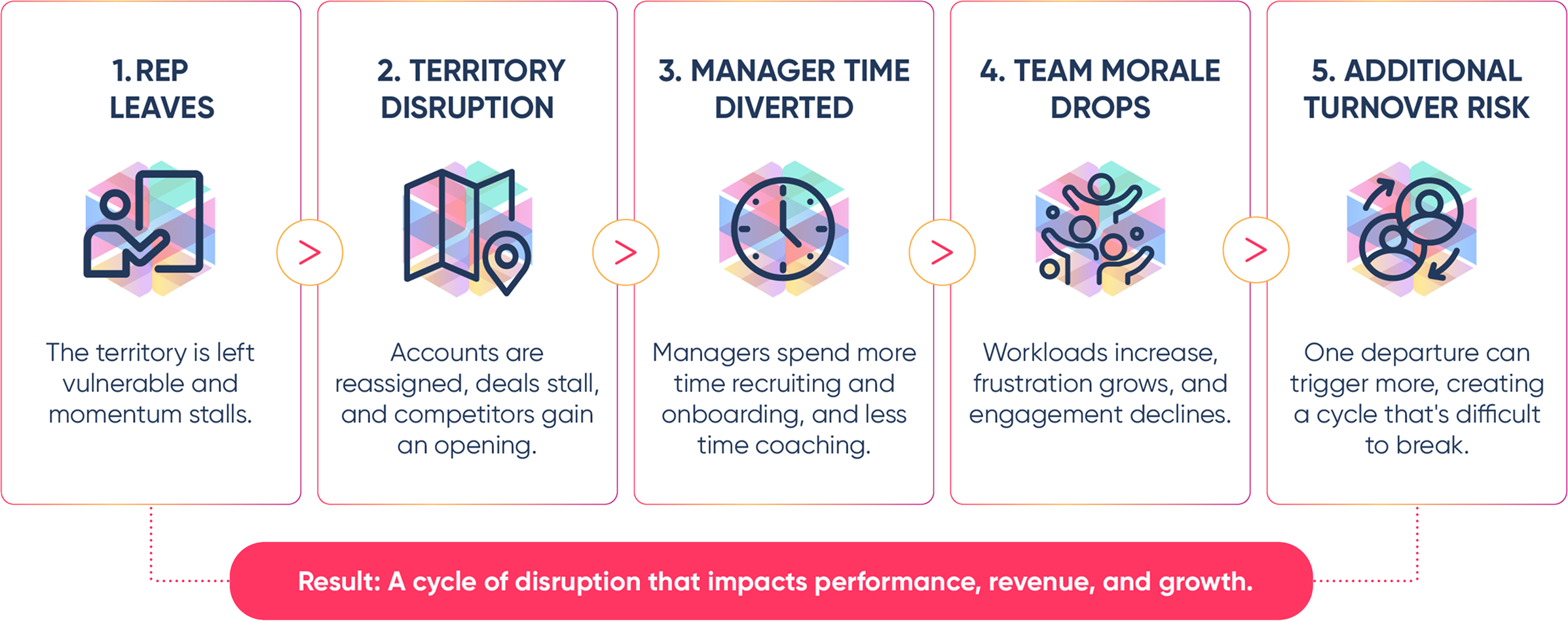
Rep turnover does not happen in isolation. When one rep leaves, the remaining team absorbs the disruption. Managers spend time on recruiting and onboarding instead of coaching and developing their current team. Territories get split temporarily, spreading existing reps thin. Morale takes a hit, particularly if the departure was driven by frustration with internal support, compensation, or lack of development opportunities.
That morale impact is the quiet accelerant. One departure can trigger another. We have worked with companies where a single high-profile departure cascaded into three or four more within the same quarter, because the underlying issues that drove the first departure were affecting the whole team.
What Drives Turnover in MedTech (Beyond Compensation)
Compensation matters. We are not going to pretend it does not. But in our experience working with medical device sales teams across cardiovascular, diagnostics, orthopedics, and wound care, the most common drivers of rep turnover are not financial. They are structural.
Inadequate onboarding
When a new rep does not feel prepared to do the job, their confidence erodes quickly. A compressed onboarding program that rushes through clinical knowledge, product training, and selling skills in two or three weeks sets the rep up to struggle in the field. Struggling reps disengage. Disengaged reps leave.
No ongoing development
The medical device field evolves constantly. New clinical data, new competitive entries, new regulatory guidance, new reimbursement dynamics. Reps who are expected to absorb all of that on their own, without structured ongoing training, fall behind. And the best reps, the ones you most want to keep, are the ones most likely to leave for a company that invests in their growth.
Disconnect between marketing and the field
When reps feel that the tools and materials they receive from marketing do not reflect the reality of their selling environment, frustration builds. They are handed a deck that does not address the objections they hear. They receive training that does not match the materials. They feel unsupported, and over time, that feeling becomes a reason to look elsewhere.
Lack of clear advancement paths
High-performing reps want to know what comes next. When there is no visible path to a senior role, a management position, or a clinical sales specialist track, the best performers go find one at another company.
How Structured Onboarding and Training Reduce Turnover
Here is the good news. Every structural driver of turnover we just described has a training or onboarding solution.
Build onboarding programs that actually prepare reps for the field
A comprehensive medical device onboarding program should run 60 to 90 days, not two weeks. It should include clinical knowledge development, hands-on practice with the product, role-play scenarios grounded in real selling situations, field ride-alongs with experienced reps, and a certification checkpoint before the new rep is expected to carry a territory independently. Reps who feel genuinely prepared in their first 90 days are dramatically more likely to stay through their first year and beyond.
Create a continuous learning track
Ongoing training should not be an annual sales meeting and nothing else. The companies with the lowest rep turnover in our experience run monthly skill-building sessions, quarterly competitive intelligence updates, and regular clinical education modules that keep their reps current. This investment signals to reps that the company values their growth, and it gives them the tools to stay competitive in a changing market.
Align training and enablement so the field feels supported
Pair new reps with experienced mentors during onboarding. Give managers a coaching framework that goes beyond pipeline reviews. Create opportunities for peer learning. These connections build the kind of loyalty and engagement that compensation alone cannot buy.
Build mentorship and coaching into the structure
High-performing reps want to know what comes next. When there is no visible path to a senior role, a management position, or a clinical sales specialist track, the best performers go find one at another company.
The Budget Conversation That Needs to Happen
When we talk to marketing and commercial leaders at medical device companies about investing in onboarding and training infrastructure, the most common pushback is cost. Training programs, learning management systems, coaching frameworks, and ongoing development curricula all require investment.
The response we always give is the same. You are already paying for turnover. You are just paying for it in ways that do not show up on a single line item. You are paying in lost revenue during ramp-up. You are paying in lost accounts during rep transitions. You are paying in recruiting fees. You are paying in manager time diverted from coaching to hiring. You are paying in the institutional knowledge that walks out the door every time a tenured rep leaves.
Where to Start
If your current onboarding program is a two-week crash course followed by a field ride-along, start by extending it. Map out what a 60-day or 90-day onboarding track would look like. Identify the gaps between what reps learn in training and what they need to know in the field. Build practice scenarios around real account situations. Add a certification milestone before reps carry a territory solo.
If you have no ongoing training program beyond the annual sales meeting, start with one monthly session. Pick the topic your reps need most, whether that is competitive positioning, clinical evidence review, or objection handling, and build a 60-minute module around it. Consistency matters more than scope. A small program that runs every month beats an ambitious program that never launches.
If you want help building these programs, that is what we do at HighPoint Experience. We build onboarding, training, and sales enablement programs for medical device companies, and we build them as integrated systems designed to prepare reps, develop them over time, and keep them performing. We have seen what happens when companies invest in this infrastructure, and we have seen what happens when they do not.
The companies investing in it are keeping their best people and growing faster. The rest are running the same recruiting cycle every year and wondering why the number never changes.
Contact us at highpointxp.com/contact.